Home  >  Rides  >  Rides by Country  >  Namibia  >  Desert Trails

Desert Trails, Namibia


Reviews


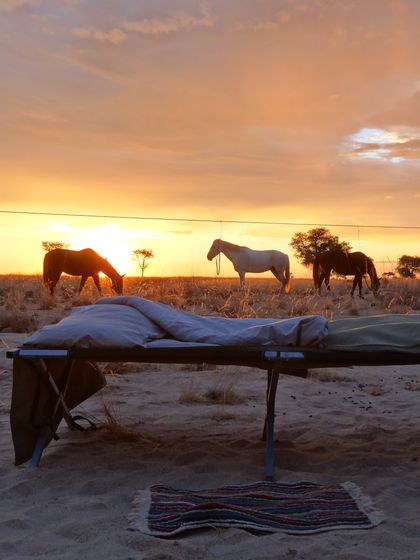
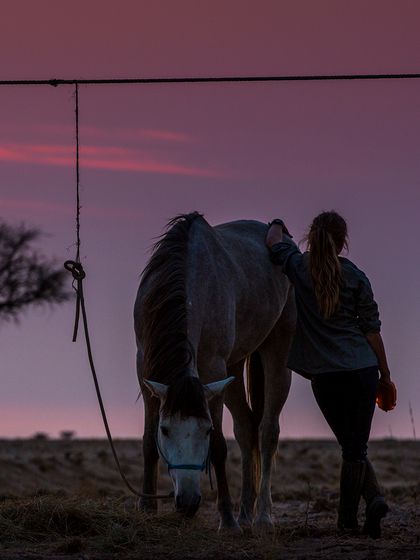
An amazing experience. A trail full of incredible beauty and full of adventure. Finishing with an incredible sense of achievement. Overall it was adventurous, wonderful, physically challenging, beautiful and re-building. My favourite memory was the vastness of the desert, watching the loose horses running free in the long grass, seeing the sunset and sleeping under the stars with my horse Leo.

Alexandra W.
 

Horses


Type of horses:

Arabs, Hanoverian, Trakehner, Lippizaner, Haflinger, ranch horses and all types of cross-breeds.

Nature of horses:

Reliable, sturdy mounts, swift and sure-footed, used to tough terrain

Height of horses:

Approximately 15hh

Weight limit:

Our weight limit is 85 kg - anyone heavier has to pay additional 30% for an extra horse.

Tack type:

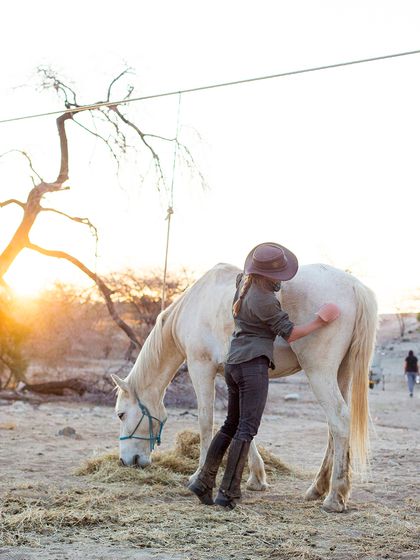
Western


Weather


Current Conditions:
Unknown, 4 C

Forecast:
Sat - Clear. High: 21 Low: 6
Sun - Sunny. High: 21 Low: 7

Full Forecast at Yahoo! Weather

(provided by The Weather Channel)
 

Pricing


Namib Desert Trail

The cost of this ride is £2136 which includes full board accommodation, all riding, transfers to and from Windhoek International airports, other necessary car transfers and bed and breakfast at coast on the last day.

Damara to Skeleton Coast trail

£2422 per person

Bushman Trail

£2422 per person

Desert Vista Trail

The price of this ride is £1282 per person.

This price includes : Transfer from Windhoek, full board at lodges and good fare while camping on the trail; excursion to the Wild Horses; picnics; transfer back to Windhoek.

This price does not include : Bottled and canned drinks on the trail and at lodges and homesteads; souvenirs; tips for local guides and crew; drinks at lodges; flights, if applicable, from Luderitzbucht; airport transfers.

Fish River Canyon Trail

The price of this ride is £2422 per person.

This price includes : Transfer from Windhoek; full board and lodging at homesteads and lodges and good fare while camping on the trail; scenic drive to the main lookout point at the Fish River Canyon; transfer from Norotshama Lodge via Klein Aus Vista Lodge with an excursion to the Wild Horses and transfer back to Windhoek.

This price does not include : Bottled and canned drinks on the trail and at lodges and homesteads; souvenirs; tips for local guides and crew; drinks at lodges; flights, if applicable, from Rosh Pinah or Luderitzbucht; airport transfers.

Availability/Booking Form
 

Ride Description

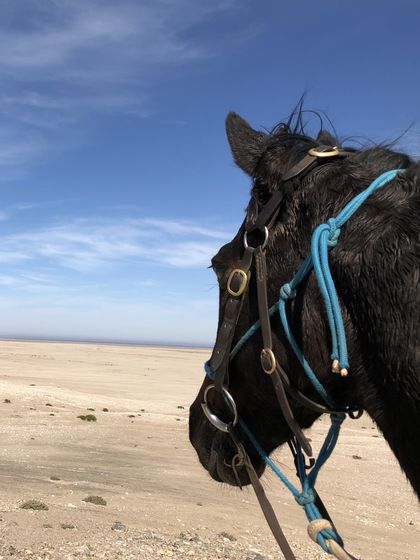
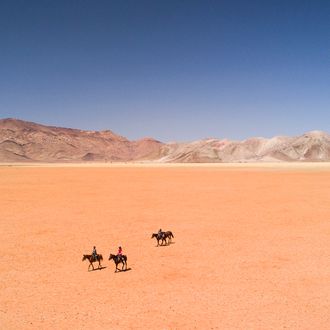
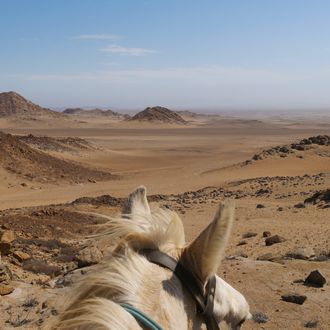
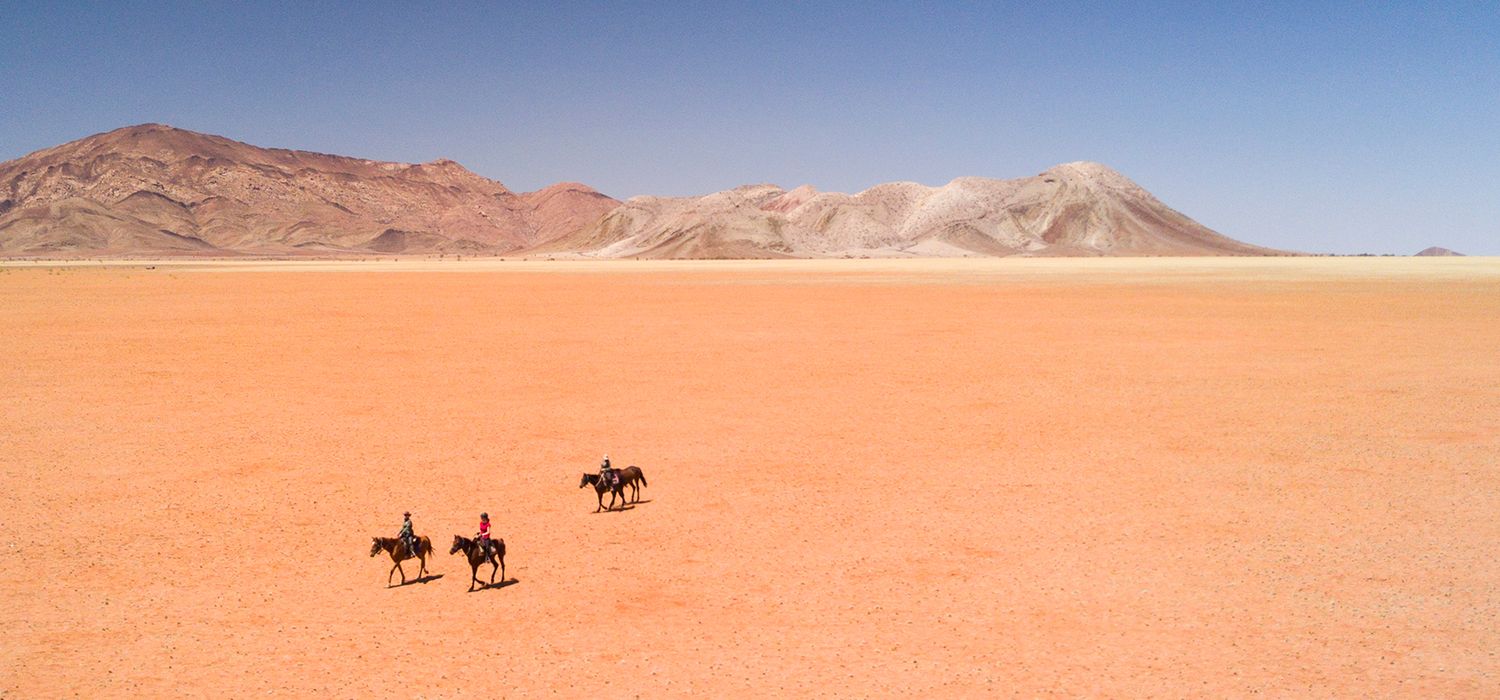
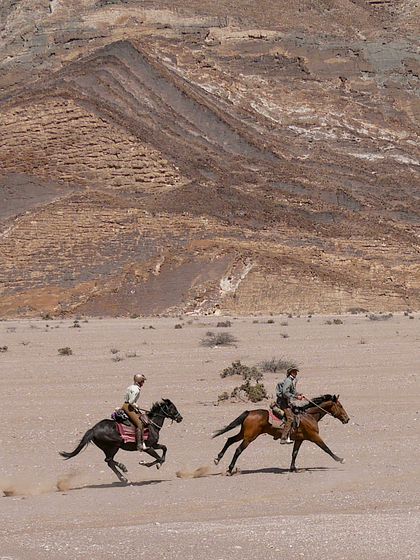
Riding in Namibia is truly spectacular. From galloping across vast open plains to cantering up an down sand dunes, all under a spotless blue sky, you cannot fail to enjoy the delights of this environment. Unlike some rides, you won't be stopping and starting but will journey across the oldest desert in the world, spending nights next to a dwindling campfire underneath the twinkling stars.

The ranch has a beautiful site on the central highland, 65 km southwest of Windhoek on the main road over Gamsbergpass to Walfish Bay. The owners and indigenous people working on the farm call these 6300 hectares their home.

The ranch is 1700m above sea level and is mainly suited to cattle breeding; due to the poor vegetation one head of cattle needs at least 14 hectares to survive. An abundance of game on the central highland, e.g. kudu, gemsbuck, springbuck, mountain zebra, ostrich, dassie and baboon incite hunters from all over the world to come for trophy hunting.

Qualified guides will lead you on this journey, sharing with you their intimate knowledge of the wilderness. You will also learn how the local people have adapted to this harsh, yet beautiful environment. Some rides will pass through Bushmanland where you can watch a demonstration of the famous hunting and tracking skills of the local nomads.

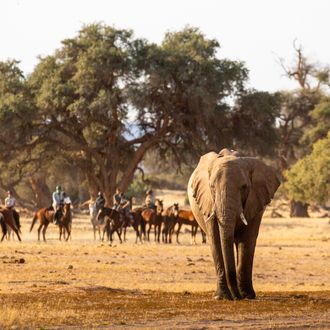
Depending on the ride you choose you can experience a range of exciting activities. Some rides will give you the opportunity to see elephants, giraffes and rhinos in a unique desert habitat whilst others take you on a discovery of ancient craters millions of years old. You can stop and search for gemstones or enjoy the site of Brandberg (highest peak in Namibia).

Voted one the top ten best rides in Africa according to 'Outside' magazine.

By joining our trails you get access to areas in Namibia unknown to tourists and even locals. As far as we know there is only one other desert trail of this kind available: Grand Canyon Trail in the U.S.A.

See Programmes.


Food & Accommodation

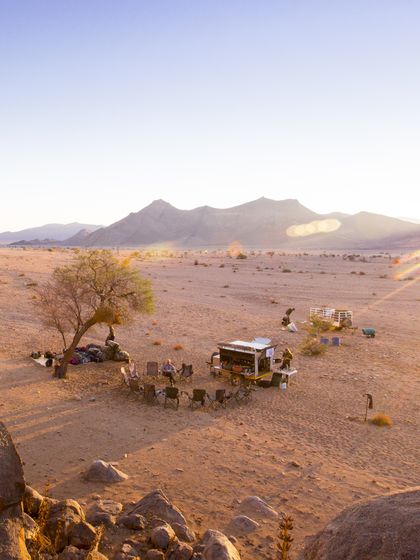
You can truly feel at one with nature on this ride and after a long day in the saddle doze off under the night stars. Almost all nights will be spent in large comfortable tents erected by local workers before your arrival at the campsite. Also awaiting you will be a cooked meal and a hot shower.

Accommodation is in big igloo-type tents (two people per tent) on camp-beds. There are swags with lambskin, duvet or continental quilt and pillow. Hot showers are provided. Luggage is transported on trucks; the riders take short-cuts through the bush or desert and meet the back-up vehicles at camp sites.

Meals are prepared for you around the open fire, usually "braai"(barbequed) or "potjiekos".
This often comes served with a porridge like mixture called mahango or pap. A hot barbequed meal after a tiring days riding will taste delicious.

Most typically Namibian food is fairly plain and vegetarians may find it challenging.

This said things are changing and many restaurants in Namibia offer a wider range of foodstuffs and some even cater for vegetarians. Please bear in mind though that you will be travelling from day to day in the heat so food served will all have to be transported.

National specialities:
• Biltong (air-dried meat).
• Rauchfleisch (smoked meat).
• Game such as antelope, ostrich or zebra cooked on a braai (barbecue).
• Potjiekos (one-pot bush stew).
• Seafood, especially oysters, on the coast.


Activities

This ride is not suitable for non-riders.

Riders are on the move continuously so any additional activities such as bushmen demonstrations or visiting gold mines are an integral part of the trail, some at an additional cost.

There are numerous opportunities for wildlife spotting of all kinds from elephants and giraffes to a variety of unusual birds. The area is a full of impressive rock formations and part of the appeal of this ride is being able to watch the ever changing colours of the landscape and the daytime mirages.


Further Details

Languages: English and German

Health requirements: Fitness, good health, experience in horse riding and dealing with horses is essential

Age limit: No specific age limit but see health requirements.

Tuition: Yes

Included: Rates include transfer from Windhoek, full board lodge (camping) on ranch and safari across desert, bed and breakfast at the coast. Some rides include extra activities (see individual itineries for details).

Not included: Flights to and from Windhoek, insurance (essential), sleeping bags, canned or bottled drinks (can be arranged at additional cost), goodbye dinner, transfer from coast after trail. . Tips for communal guides and grooms.


Travel Information

Flights can be booked with Air Namibia from London Gatwick to Windhoek flying overnight on Wednesdays, Fridays and Sundays. Return flights from Windhoek to London Gatwick fly overnight on Tuesdays, Thursdays and Saturdays.
Flights may not match up with the start of the ride and so it might be necessary to stay overnight at Windhoek. We can arrange this.
Daily flights are available to and from Windhoek via Johannesburg

Airport: Windhoek International

Alternative Airport: Eros


Programmes


Namib Desert Trail


This trail encompasses 9 days on horseback covering a total 400km across the ancient Namib desert plus 3 days either on the farm or by the coast.

Pick-up on arrival day at 10h00 and 16h00 in Windhoek in front of Kalahari Sands Hotel opposite bus terminal (take airport bus to Windhoek). You will be met in Windhoek and taken to the farm 65 km south west of Windhoek.

Here you stay for another day, getting to know your horse, the route and fellow-riders.

The actual desert trail starts on Day 3, when you leave the farm early in the morning. From 1750m above sea level you ride through seemingly endless, gentle undulating hills onto the central highland (2000m). You then reach the edge of the escarpment with its breath-taking precipitous mountain faces glowing in the light of the setting sun. Another 1 - 2 hours' ride down double bends and serpentines brings you to the camp site, where you meet the trucks which carry baggage and all the other necessary accessories. Sleep in a tent or beneath the stars after a good meal cooked on the camp fire and catch up on the day together.

Day 4 is a tough one, as you ride onto and over the Hakos-mountain range (2000m above sea level). Mountain zebra, oryx and other game as well as leopard caves, slopes, precipices and geologically fascinating sights make this an experience never to forget. And you certainly appreciate a hot shower and a good meal at the end of the day!

On Day 5 you visit an old gold mine not far from the camp site; after that a short ride (20km) to the red sand dunes of Rooisand.

Day 6 takes you over the last semi-desert farms to a camp near the Namib-Naukluft Park.

Day 7: Ride into the park, down the Kuiseb-pass with its incredible rock formations and to Aruvlei in the Namib desert. By now you will have realised that the Namib is not all waving sand, but a land of ever-changing terrain and landscape.

Day 8: A long ride right across the lonely desert through a concealed donga to Ganab and Hotsas near Bloedkoppie (Tinkas Plane) with a spectacular sunset in the desert.

Day 9: From Hotsas over Tumas-plane right across the desert to Poacher's Turn and the Marble Mountains, unlimited space, mirages and tremendous solitude.

Day 10: Across Welwitschia-Plane to Moon Valley and into the Swakop-river bed. Camp underneath palm trees and prosopis of the Goanikontes oasis.

Day 11: A joyous ride along the Swakop-river valley to the dunes of the Namibian coast and then at last to the shore of the Atlantic Ocean at Swakopmund. This is your first communication with a town in 10 days. No more camp with tents next to resting horses - you stay in a holiday house near the beach, while the horses enjoy their well-deserved rest in cosy stables. Those who want more luxury can happily stay in a hotel at their own expense (for applicable arrangements please tell us before you come).

Day 12: Bare-back to the dunes and along the sea shore; enjoy a last canter on the beach or go for a swim in the waves; perhaps you can convince your horse that the waves are not dangerous.

Day 13: Breakfast and then bid your friends good bye.

Minimum group size: 5
Maximum group size: 12
Ability description: This is a demanding ride and riders should be physically fit with riding experience.
Type of ride: Trail riding
Total riding time: Long hours in the saddle
Departure dates: 2009: 6 - 17 April; 3 - 14 August; 24 August - 4 September; 6 - 17 October
Pricing: See Pricing


Damara to Skeleton Coast trail


Day 1: Drive from Windhoek to Damaraland - You will be met you at the airport or in Windhoek - Air Namibia arriving early morning, otherwise overnight in Windhoek at own expense. Leave Windhoek early in the morning, lunch pack to be picked up at Otjiwarongo. Picnic at the petrified forest or along the road before driving on to Aba Huab. Meet horses and crew and settle at Aba Huab Camp. In the evening campfire stories and preparation for seeing the elephants.

Day 2: Be ready for trial ride after a relaxed breakfast. Sight seeing and walk to famous rock engravings in the afternoon. Enjoy the spectacular views of Damaraland and unwind until its time for dinner and another beautiful evening around the campfire.

Day 3: From Aba Huab over the endless planes to Rendezvous (lunch) and then along the Aba-Huab River to De Riet.

Day 4: On along the Huab River and over another Damaraland plane towards Mikberg where cheetah have been spotted. Lunch at the cheetah tree and a long afternoon ride through fascinating landscape. Night camp at View Point enjoying the sight of Brandberg (highest peak in Namibia) and Doros Crater.

Day 5: From View Point southwest towards the Ugab River. Lunch camp at Lion Head, in the afternoon a nice long canter and then into a very narrow gorge past Soutfontein (salt fountain) to the Rhino trackers´ camp near Brandberg West. Only by flying you realise how spectacular this countryside is (preferably afterwards!). Meet the Save The Rhino Trackers and perhaps have a slide show on request.

Day 6: All along the Ugab, passing its reeds, lion bush thickets and Brakwasser, another bitter tasting water place frequented by elephants. Once we got trapped in the canyon between two herds of elephants and last time we rode past a fresh lion kill and on warm tracks most of the morning. Whether there is a river in flood, quick sand, dust, reeds or elephants depends on the previous rain season. After a short hot lunch break you turn away from the Ugab river south east through another narrow gorge to Welwitschia Camp. Here you come past famous Damaraland formations and otherwise inaccessible Ugab sediments.

Day 7: From Welwitschia Camp onto wide open Damaraland planes with a spectacular view on Brandberg and Doros Crater; purple coloured rocks all over being the remnants of Messum Crater's horrifying blasts millions of years ago. Marvellous cantering and lunch at Klippenberg where you can pick up some gemstones; night camp at Cross Roads.

Day 8: Towards the Messum River. Only half a day riding; in the afternoon we you are taken for a scenic drive in and on the back-up vehicles all along the Messum River to the largest Welwitschia plants and amazing wind erosion sites.

Day 9: Straight towards the Atlantic Ocean - camp at Mile 108 on the beach, no luxury whatsoever, only our trucks and some simple wind shelter. You may fear that the waves could sweep over your tent on the beach at night. The coast may have east wind and such warm weather that you can swim at sunrise …. or a sandstorm which leaves plates flying around …. or a nasty nerve teasing wind …. or dense fog which has everyone shivering and asking for Glühwein and a hot fire! Not for nothing this unpredictable place is called the Skeleton Coast!

Day 10: After a last early morning ride along the beach, load horses and wave horses and crew goodbye. Own transfer arrangements to Hentiesbay if you want to stay another night (affordable De Duine Hotel, or stunning Cape Cross luxury lodge near the seals and Mile 108, or even the new famous Hydro Wellness Centre in Hentiesbay - all at your own expense). The cherry on top is to fly in a small aircraft back over the route we took, optional Sossusvlei (price depends on number of riders); otherwise transfer by car to Swakopmund or Windhoek. Usually we co-ordinate transfers to save on costs and make life easier!

Riding is easier than on the Namib Desert Trail with more time for relaxation because of more days travelling, much faster riding and no mountains to be crossed

Minimum group size: 6
Maximum group size: 12
Ability description: Only for those who have done the Desert Trail, experienced riders familiar with our horses, terrain and style, those who can "ride for their lives", if necessary.
Type of ride: Trail riding
Total riding time: Very long hours in the saddle.
Departure dates: 2009: 7 - 16 July
Pricing: See Pricing


Bushman Trail


Experience the bush and shrub savannah, desert planes and pans and huge Baobab trees on a 10 day tour.

Day 1: You leave Windhoek not later than 10h00 and drive via Okahandja, Otjiwango, Otavi and Grootfontein to Dornhügel, so that you arrive there early enough to meet the crew and horses, go for a swim, enjoy a sun-downer and the beautiful sunset in this typically African landscape..

Day 2: Tack up and go; no trial ride, but go directly over farms named Sachsenwald en Oopval, vast commercial farming area with palm trees, small coal processing and open valleys. Evening camp at Blystroom in Reitsafari fashion!

Day 3: Enter the private game park Eden which has an amazing number of game and different bird species. You ride towards the big pan and from there, as the crow flies, towards the usually dry Omuramba Omatako, one of those dry riverbeds flowing towards the Okavango Swamps in the Kalahari. Lunch at Omatako, night camp at Morestêr.

Day 4: Ride a small distance to the nearby loading ramp, load horses and tack and let them travel to Tsumkwe to avoid a very boring part of Bushmanland. Riders travel from first world commercial farming area across the Red Line at Rooidaghek into third world communal Bushmanland. We visit a Bushman settlement and join their day to day life. Drive on to Tsumkwe, visit the souvenir shop and meet the crew and horses near Tsumkwe Lodge. We go camp with the horses, but you can happily spoil yourself by renting a luxurious bungalow at the lodge at own expense (price and reservation on demand).

Day 5: Meet our pickup at the Nyae- Nyae Pan for lunch and continue to the incredible Baobab Tree where camp is set up 2 nights. Usually some Dxo.hwe-bushmen show up and an appointment is made for the next day for for a demonstration of their famous hunting and tracking skills in the bush.

Day 6: Spend the day with the Bushmen and follow the tracks of the elephants.

Day 7: Following the elephant via Maheri either to Baraka or into the vicinity of Grenspos and Aha-Mountains - depending where the elephants are!

Day 8: Searching with the bushmen for elephants. Hopefully they can be sighted and the night is spent camping probably close to the Aha-Mountains.

Day 9: Ride to the main road (Botswana border), load the horses and travel back to Dornhügel. Enjoy our last dinner together and share stories.

Day 10: After breakfast transfer back to Windhoek

Minimum group size: 6
Maximum group size: 12
Ability description: For those who want an easy ride with typically African adventures and images, the Bushman Trail is the perfect starter.
Type of ride: Trail riding
Total riding time: Long hours in the saddle
Departure dates: Only on sufficient demand, minimum of six riders
Pricing: See Pricing


Desert Vista Trail


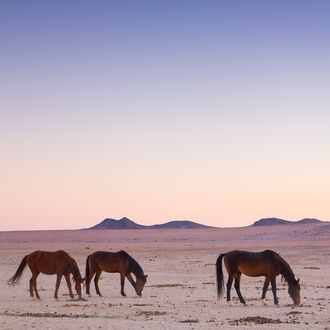
Diamonds, dunes and desert - This trail takes place on historic ground in the area of the Wild Horses of the Namib, next to the Restricted Diamond Area. It is a circular trail of five or six days which starts and ends at Klein-Aus Vista's Desert Horse Inn and Eagles Nest.

The area around Aus, a little village close to Klein-Aus Vista, is quite unique in Namibia. It has even been called Namibia's Switzerland - due to occasional snowfalls which may cover the mountains with a white blanket, although usually for only a few days at most. More importantly it is an area with an exceptionally diverse flora because three desert biomes overlap here: the Namib Desert, the Succulent Karoo and the Nama Karoo. Depending on the rainfall, wild flowers may be out in bloom forming colourful carpets in spring or even in autumn. As the trail combines a variety of landscapes, from mountains to vast open plains and sand dunes, riding will be slow in some places, but fast with exhilarating canters in others.

Day 1

Meet your hosts at 8.00 hrs at the Tourist Information kiosk in downtown Windhoek. The kiosk is at the airport bus terminal and taxi rank opposite the Kalahari Sands Hotel. The journey from Windhoek to Aus takes about eight hours, including a picnic. You arrive at Klein-Aus Vista's Desert Horse Inn, just west of Aus, in the late afternoon where you will meet your fellow riders, hosts, guides and local crew.

Day 2

You get mounted and follow a rocky trail, built by German soldiers, to an old "transport and breeding station" in the Aus mountains. On the way you visit an archaeological site with Bushman paintings. After lunch you continue through this interesting mountainous terrain to your first camp, pitched at Leopard's Gorge. You may spot oryx, kudu, klipspringer and rock hyrax as well as birds of prey during this ride.

Day 3

Leopard's Gorge to Kuckaus Camp. The day starts slowly but picks up momentum as you cross some mountain slopes before venturing onto the red sandy plains of Rooikam (Red Ridge). In the afternoon it is mostly downhill to an eccentric inselberg called Kuckaus. Imagine a totally unspoiled landscape of vast desert plains with a few prominent hilltops.

Day 4

Kuckaus Camp to Paddaputs (Frog's Well). After breakfast you explore the fascinating diversity of fauna and geology around Kuckaus Mountain. Then you head north again across the plains, parallel to the border of the Restricted Diamond Area, to some smaller rocky outcrops and your next camp.

Day 5

Paddaputs to Ausweiche. Riding uphill to the watershed you come across the old transport or ox wagon route between Aus and Luderitz. The people of those early years who conquered the desert at the mercy of unpredictable weather conditions just have to be admired. You follow the old route for a while and then turn to the big "Sand Ramp" at Ausweiche. Your camp on this "dune" at the foot of Saddle Hill affords the most magnificent view of the desert home of the Wild Horses of the Namib.

Day 6

Ausweiche to Eagles Nest or Geisterschlucht. Riding across sandy plains, you then return to Klein-Aus Vista for lunch. The afternoon is for relaxation and for a sunset excursion to the Wild Horses. In the evening you have a farewell dinner.

Day 7

After an early breakfast you drive west through the desert towards the harsh Atlantic Coast at Luderitz and visit the ghost town of Kolmanskuppe where diamonds were mined early last century. You depart from Luderitz after lunch and drive six hours to Anib Lodge in the Kalahari Desert. Alternatively, you can fly from Luderitz to Windhoek or Cape Town.

Day 8

After breakfast you depart from Anib Lodge for the three hour drive to Windhoek.

Minimum group size: 6
Maximum group size: 12
Ability description: Fitness, good health, experience in horse riding and handling horses are essential. You do not need to be an accomplished dressage rider or show jumper, but you must feel totally at ease on the back of a cantering horse.
Type of ride: Trail
Total riding time: 6-8 hours per day
Departure dates: 2009: 27 October – 3 November
Pricing: See Pricing


Fish River Canyon Trail


Combining dramatic canyon landscapes, vast desert plains and the mighty Orange River, the challenge of this trail is by no means less than that of the Central Namib Desert and the Damaraland to Skeleton Coast trails. The trail covers rocky hills, riverbeds and gravel plains - at times the going is tough and difficult. Participants experience real wilderness areas, which are otherwise almost inaccessible, as well as the freedom of riding without restrictions. The pace depends on the terrain and temperatures as well as on the fitness and weight of the riders.

The Fish River Canyon is the second largest canyon on earth and internationally recognised as one of Africa's most magnificent natural features. You will start off in and along the upper canyon. After the seemingly endless Nama Karoo scenery the plains will tempt you to canter all the way to the Orange/Gariep River, which forms the southern border of Namibia. Distances covered per day vary between 20 and 55 kilometres.

The Fish River Canyon Trail runs through three private nature reserves - Fish River Canyon Park, Gondwana Canon Park and Aussenkekr Park - which together cover an area of some 220,000 hectares. These parks are part of the Nama Karoo Desert biome, situated on the fringe of the transitional area between Nama Karoo and Succulent Karoo. The valley of the Orange River at Aussenkehr is the most arid part of the Nama Karoo biome. Aussenkehr Park is also home to a small population of feral Namib horses. They are descended from a group of seventeen horses which were relocated during the 1992 drought from the original wild horse population at Garub in the Namib Desert.

Included in the itinerary is an excursion to the main lookout point at the spectacular Fish River Canyon and an afternoon/sunset drive to the famous Wild Horses of the Namib.

Day 1

Meet your hosts at 8.00 hrs at the Tourist Information kiosk in downtown Windhoek. The kiosk is at the airport bus terminal and taxi rank opposite the Kalahari Sands Hotel. The transfer from Windhoek to the northern Fish River Canyon takes about eight hours, including a picnic. In the afternoon you arrive at Augurabis, an almost forgotten farmstead, well hidden in lush vegetation close to a natural spring in the Gaap River. Augurabis is located in Gondwana Canon Park, a private nature reserve of some 120,000 hectares, dedicated to nature conservation.

Day 2

After breakfast and briefings you go on a "trial ride" to get acquainted with the horses, the riding style and the terrain that you are going to explore. You can take a leisurely ride along the Gaap River and into the surrounding area. The afternoon is at your disposal for relaxation, hiking, taking pictures,etc. At this point you will need to pack a small bag with just the essential items for two days. Four-wheel drive vehicles will transport everything necessary, but it should be as little as possible as vehicle tracks are non-existent or poor in the wilderness.

Day 3

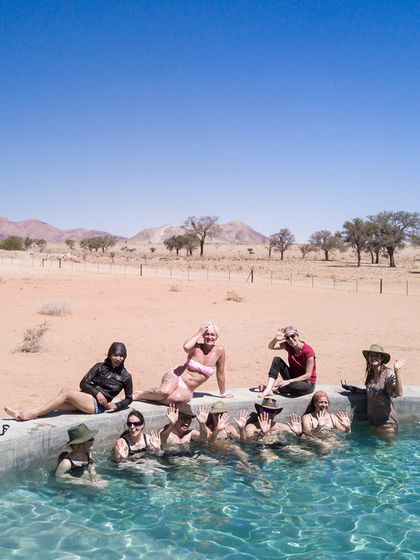
Augurabis to Koeikrans ("cool cliffs"). This is serious riding over varying terrain where you may spot mountain zebra, Oryx, klipspringer and rock hyrax as well as birds of prey and owls. The canyon will greet you with stunning views. You will stop at the lookout point and then descend into the massive gorges. The camp is pitched at a large natural pool surrounded by steep cliffs. You will perhaps appreciate a swim in this otherwise extremely dry area.

Day 4

From Koelkrans to Sandy Beach or Flamingo Bay - the names are as extraordinary as the setting. You might even see a flamingo in the desert. The trail follows a section of the Fish River where few people have set foot before. Who can tell what lies in store - whether you ride through the canyon or on zebra tracks around the rim depends on the water level in the river.

Day 5

From Flamingo Bay through the Gaap River back to Augurabis. You continue further down the Fish River to where it is met by the Gaap River and then follow the Gaap's own winding and interesting passage upstream, past the desolate ruins of a homestead and further on into an unexpected, dense riverine forest. Back at Augurabis you are reunited with all your belongings.

Day 6

Augurabis to Holoog Mountain. Leaving the canyon behind you move on zigzag paths through bizarre weathered rocks towards the southeast where the basalt ridges open onto a vast plain, to enjoy some fast cantering and larger numbers of game like Burchell's zebra, springbuck and ostrich as well as herds of Oryx. As you find yourself in fenceless surroundings you will not be bound to a specific route. You camp in a dry riverbed at the foot of Holoog Mountain on a wide open terrain with a grand panorama. You will have your entire luggage at your disposal and camp facilities are available.

Day 7

Holoog Mountain to Canon Mountain Camp. You ride through miles and miles of savannah into an area dotted with granite boulders and charasmatic quiver trees, to arrive at Canon Mountain Camp for lunch. The afternoon includes a drive to the main lookout point at the Fish River Canyon, where "ordinary" tourists go hiking and sightseeing. You will be amazed to see where you went on horseback just a few days earlier. Enjoy a little luxury and a very special evening at Canon Mountain Camp.

Day 8

Canon Mountain Camp to Fourie se Gat ("a hole dug by Mr Fourie"). You ride parallel to the Fish Rtver Canyon across vast open savannah where game is abundant. Distant hills form a boundary in the east, while the awe-inspiring canyon landscape accompanies you in the west. Sunsets over the Fish Canyon "badlands" are spectacular, illuminating the granite hilltops behind you and the sandy plains of the Gamkab basin ahead of you, with Norotshama peak on the afternoon horizon.

Day 9

Fouie se Gat to Gamkab Camp. As you approach the Orange River valley the trail is winding through granite hilltops part of the way, until you reach wide open spaces of ever changing scenery. Your campsite is a cosy spot next to the Gamkab River.

Day 10

Gamkab Camp to Boulders Camp. You ride across a patch of isolated sand dunes and enter the Aussenkehr plains. Your camp is surrounded by boulders, stacked as if giants had been at work with toy bricks. Again, you are not bound to a specific route and can roam your surroundings freely.

Day 11

Your last ride. The contrasts are stunning yet again. From the wide open plain you ride into the very narrow King's Throne Canyon. The view from the lookout point is simply amazing : lush vineyards on the banks of the Orange/Garlep River in an otherwise barren landscape. After another happy canter and a stroll through the vineyards you finally unsaddle at Noroshama River Resort on the riverbank. You can take a swim in the pool (or the river) and enjoy sundowners on the river and dinner at the lodge.

Day 12

Early birds may want to go for a short canoe trip downstream, before you leave for Klein-Aus Vista later in the morning. First you drive along the Orange River, then turn north to Rosh Pinah and continue next to the Diamond Restricted Area to Aus. Join a sundowner excursion to the Wild Horses of the Namib, with an experienced guide, later in the afternoon.

Day 13

Depart for Windhoek after an early breakfast, for a seven-hour transfer. Alternatively, you can fly to Windhoek or Cape Town from Rosh Pinah on day 12, or from Luderitz which is an hour's drive from Klein-Aus Vista.


Alternative itineraries:

It is possible to book just part of this trail -

1. Northern Canyon Trail
8 days, 7 nights, Sunday to Sunday (day 1-7 plus return transfer).
6 days riding, 2 days for transfers and an excursion to the main lookout point at the Fish River Canyon.

2. Southern Plains Trail
7 days, 6 nights, Saturday to Friday (transfer to Cafion Mountain Camp, join the Fish River to Orange River trail for day 8-13). 4 days riding, 2 days for transfers and a visit to the famous Wild Horses of the Namib.

Minimum group size: 6
Maximum group size: 12
Ability description: Physically fit. Extensive riding experience and handling horses essential. You must feel totally at ease on the back of a cantering horse. At times the going is tough and difficult across different terrains.
Type of ride: Trail
Total riding time: 6 - 8 hours per day
Departure dates: 2009: 26 May - 6 June; 16 - 27 June; 14 - 25 September
Pricing: See Pricing